Building ai.r — Responsible AI at Enterprise Scale
How we built an AI-powered Applicant Tracking System that processed applications from 150+ countries, reduced recruitment costs by 52%, and delivered compliant, bias-aware hiring at enterprise scale.
Executive Summary
We built ai.r, an AI-powered Applicant Tracking System, for in-house recruitment teams at medium to enterprise-sized organisations to help them gather, assess, and progress candidates significantly faster.
The recruitment landscape has changed dramatically. Application volumes have increased at scale, while most Applicant Tracking Systems have failed to evolve beyond basic workflow management. Core capabilities such as intelligent matching, automated interview scheduling, CV parsing, and data enrichment are either missing, fragmented, or too slow to be effective at enterprise volumes.
At the same time, the introduction of the EU AI Act has raised the bar for how AI can be used in recruitment. Match scoring systems must now be transparent, repeatable, consistent, and bias-aware — ruling out opaque or purely generative approaches.
ai.r was designed from the ground up to meet these challenges. We built a compliant match scoring system that does not rely on Large Language Models or naïve keyword counting. Instead, our proprietary approach leverages vector embeddings in a novel way, forming part of our core IP, to generate candidate relevancy scores between 0% and 100%.
The platform is built on AWS and makes selective use of modern AI techniques including LLMs, Retrieval-Augmented Generation (RAG), agentic search, and vector databases, alongside deep integrations with job boards, Microsoft tooling, and automated email workflows. Security is embedded by design, aligned to ISO 27001 standards.
Key Outcomes
- •52% reduction in recruitment costs
- •63% reduction in agency fees
- •20% reduction in time-to-hire
- •Processing under 8 seconds (vs. minutes for comparable systems)
- •Applications processed from 150+ countries
The Problem Space: Why Recruitment Software Is Broken
Recruitment has quietly become a high-volume data problem — yet the tools used to manage it have barely evolved.
One-click applications, global job boards, and remote work have driven application volumes to unprecedented levels. For many roles, hundreds or even thousands of candidates apply within days. While this should improve hiring outcomes, it has instead overwhelmed recruiters and slowed decision-making.
Most Applicant Tracking Systems were designed as systems of record, not systems of intelligence. They focus on storing CVs and moving candidates between stages, rather than helping teams assess suitability at speed. Capabilities such as intelligent matching, structured data extraction, interview scheduling, and candidate enrichment are often missing, bolted on, or too slow to be useful.
As a result, recruiters are forced into manual screening, inconsistent judgement under pressure, and heavy reliance on agencies. Costs rise, time-to-hire increases, and bias risk grows.
The rapid adoption of AI has added further complexity. Many platforms now offer "AI matching" powered by opaque or generative models that are difficult to explain, audit, or reproduce. With the EU AI Act, this approach is no longer viable for regulated hiring environments.
ai.r was conceived to address this gap — not as another workflow tool, but as an end-to-end recruitment platform designed for scale, speed, and responsible AI adoption.
Our Approach: Designing an AI System Recruiters Actually Trust
Designing an AI-driven assessment system that recruiters genuinely trust is significantly harder than achieving raw technical accuracy.
Hiring decisions are inherently subjective. What one recruiter considers a strong fit, another may not. At the same time, recruitment teams face growing regulatory and reputational risk from biased or opaque decision-making. ai.r was therefore designed to enhance human judgement, not replace it.
Human-in-the-Loop by Design
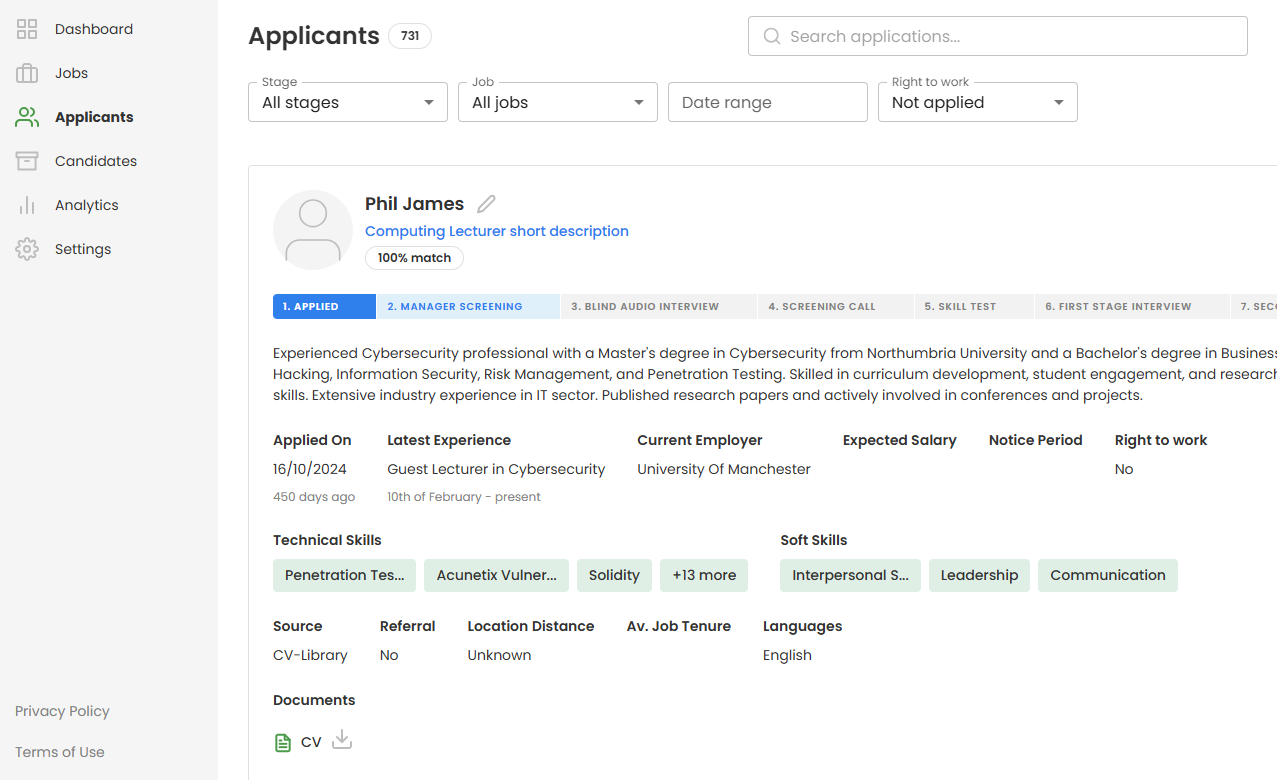
Candidates are ranked from 100% to 0% based on relevance, allowing recruiters to prioritise quickly. Each candidate is presented as a single, information-dense tile combining:
- •The match score
- •A short AI-generated summary of experience
- •Extracted technical and soft skills
- •Key contextual CV information
This enables rapid, informed decisions without forcing recruiters to read every CV upfront or navigate multiple screens.
Reducing Bias Through Anonymisation and Structured Assessment
For many organisations, reducing unconscious bias is a core hiring objective. We built simple but powerful tools to support this without adding friction.
ai.r includes anonymisation that removes or masks information known to introduce bias, including names, gender indicators, interests, and other non-job-related attributes. Facial recognition is used to detect and obscure profile images where present.
These tools are optional and configurable, allowing teams to align anonymisation with their internal policies and values.
Anonymised One-Way Interviews
Bias can also be introduced during interviews. ai.r supports anonymised asynchronous interviews, where candidates record answers to standardised questions. Each response is processed so that:
- •Every candidate's voice is transformed to the same neutral voice
- •A full transcript is generated
Recruiters assess candidates based on the substance of their answers, not age, gender, accent, or ethnicity. Standardisation also improves fairness and comparability.
Building for Consistency, Not Opinionated AI
We deliberately avoided requiring recruiters to manually weight skills. Instead, we worked closely with in-house recruiters and agencies to understand how humans actually assess CVs.
Our match scoring process was designed to mimic this behaviour in a consistent, repeatable, and explainable way.
Choosing Reliability Over Novelty
We tested LLM-based scoring approaches but found them insufficiently consistent for regulated hiring. Variance between runs and sensitivity to prompts made them unsuitable for core assessment.
An embedding-based approach delivered the stability, speed, and repeatability required for production use.
Proven Outcomes
- •75% of hires were made from candidates ranked in the top 25%
- •Recruiters reported significant efficiency gains
- •Adoption remained high due to trust and transparency
Architecture Overview: From Concept to Production AI Platform
ai.r was built through extensive experimentation and benchmarking across models, data pipelines, and infrastructure.
We evaluated multiple LLMs and embedding models against accuracy, latency, and cost. Different embedding dimensions, extraction strategies, and composite scoring approaches were tested before developing proprietary algorithms to normalise scores between 0% and 100%.
While LLMs were used selectively, our testing showed that embedding-based matching delivered faster, more repeatable results for core scoring.
Vector Storage and Performance
We evaluated several vector databases before selecting pgvector. As we already used PostgreSQL, this enabled fast integration, lower operational complexity, and strong performance without introducing unnecessary infrastructure.
Parsing and Enrichment
We built our own parsing pipeline combining OCR and LLM-based extraction, iterating across models and architectures. Over time, we reduced end-to-end parsing from ~20 seconds to under 8 seconds, while extracting richer, more accurate data.
Cloud Infrastructure and Security
ai.r is built on AWS, enabling scalability, observability, and security by design. We adopted Drata to manage controls, policies, and training, ensuring continuous alignment with ISO 27001 standards.
AI in Practice: How Machine Learning Operates in Production
All core AI capabilities — match scoring, parsing and enrichment, anonymisation, AI search, and interviewing intelligence — were built as standalone services.
ai.r integrates with this AI engine via APIs, allowing other systems to plug into the same intelligence layer.
Candidate Assessment Pipeline
- Job descriptions are parsed and embedded to extract key requirements
- Applications trigger webhooks that ingest CVs
- CVs are parsed and enriched via AWS Lambda into structured JSON
- Bias-prone data is anonymised and images obscured
- CV embeddings are compared to role embeddings
- Results are normalised into a 0–100% relevancy score
AI Search
Using vector search, ai.r can scan thousands of candidates in under one second, instantly identifying strong matches from existing databases and eliminating manual Boolean search.
Speech-to-Spec
Hiring managers can record job requirements verbally. These are converted into structured, inclusive job descriptions that feed directly into the same AI pipeline.
Responsible AI & Compliance by Design
ai.r was built with the assumption that recruitment AI would be regulated.
The platform aligns with EU AI Act requirements by design:
- •Transparent, repeatable scoring
- •Bias-aware assessment
- •Human oversight at every stage
- •No automated hiring decisions
We partnered with an independent third party to test match scoring for bias-related risks, providing additional assurance for enterprise and regulated customers.
Security is embedded throughout the platform, with continuous monitoring and governance aligned to ISO 27001.
Outcomes & Impact
Within two years, ai.r reached enterprise adoption and global scale, processing applications from candidates in 150+ countries.
Customers have reported:
- •52% reduction in recruitment costs
- •63% reduction in agency fees
- •20% reduction in time-to-hire
Customer Feedback
"ai.r has been a game changer for our business. Using ai.r we've been able to reduce our time to hire to 15 days for some roles."
"You saved us half a day of sifting on just one job."
"I'm a believer! I had over 250 candidates apply for a role and ai.r accurately identified 11 out of my top 12 applicants."
What This Demonstrates About Our Consulting Capability
ai.r demonstrates Epoch's ability to design and deliver AI systems that operate reliably in high-stakes, regulated environments.
It shows how we:
- •Translate ambiguous problems into production systems
- •Balance innovation with regulation and risk
- •Select technologies based on evidence, not hype
- •Build modular, API-first platforms
- •Embed responsible AI by design
Ready to Build Your AI Solution?
If you are exploring how AI can be applied responsibly within your organisation — whether to improve decision-making, reduce manual effort, or unlock value from complex data — we'd love to talk.
Epoch partners with teams to design, build, and deploy AI systems that are trusted, compliant, and proven in production.
Get in touch